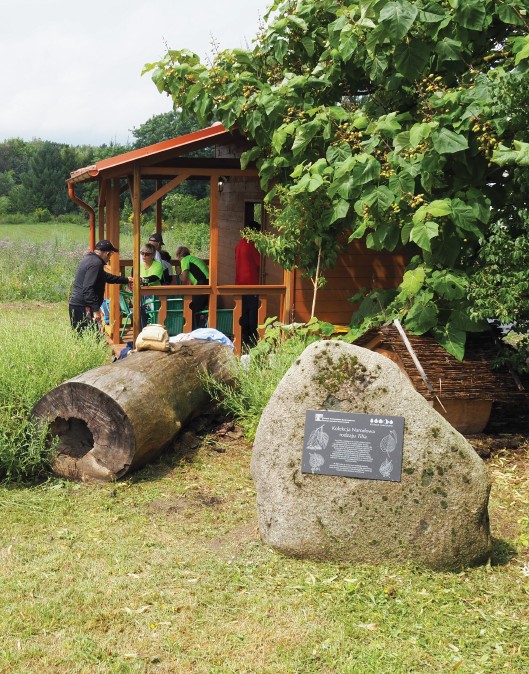
The National Collection of Genus Tilia was certified on 13th of August 2024 by the National Collections Comission of the Polish Dendrological Society. It is situated in the Arboretum of Chwalecice (near Gorzow Wielkopolski).
Identification of species has been carried out based on the identification key published by International Dendrology Society2) and Donald Pigott's monograph1) from 2011. The latter recognized 23 species and 14 subspecies within genus Tilia. The only departure made from the Pigott's division, is rejection of North-American species Tilia caroliniana (with 3 subspecies), which has been identified as geographical variety - Tilia americana var. caroliniana - instead. Differentiating only one, but very varied species in the North America is justified by research of many authors; James Hardin3) among others. With this correction the number of accepted species is 22, subspecies: 11.
After the publication of Pigott's monograph, the linden trees of the north Iran were the subjects of insightful research by two teams of local botanists. First of them recognized, based on the morphological differences, two new species which can be found in the mountain range Elburs (Persian: Alborz). The second team named species Tilia hyrcana, based on genetical research.
In this Collection, called "Garden of Hundred Linden Trees" (Polish: "Ogród Stu Lip"), there are 163 taxa (as of December 2024); among those: 23 species (counting T. hyrcana) and 6 subspecies.
One can find here taxa difficult to keep in our climate:
- Tilia mandshurica, from cold continental climate
- Tilia americana var. mexicana, from the mountains of Mexico
- Tilia endochrysea, from southern mountains of China and Vietnam
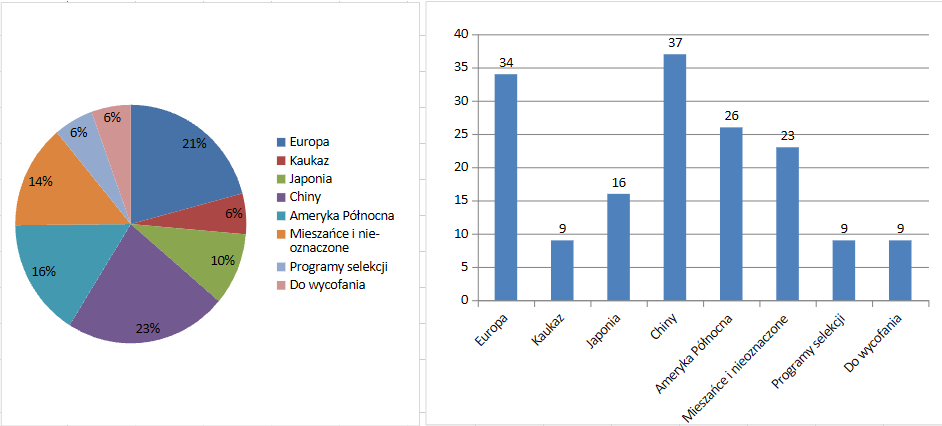
Taxa, divided by geographical origin
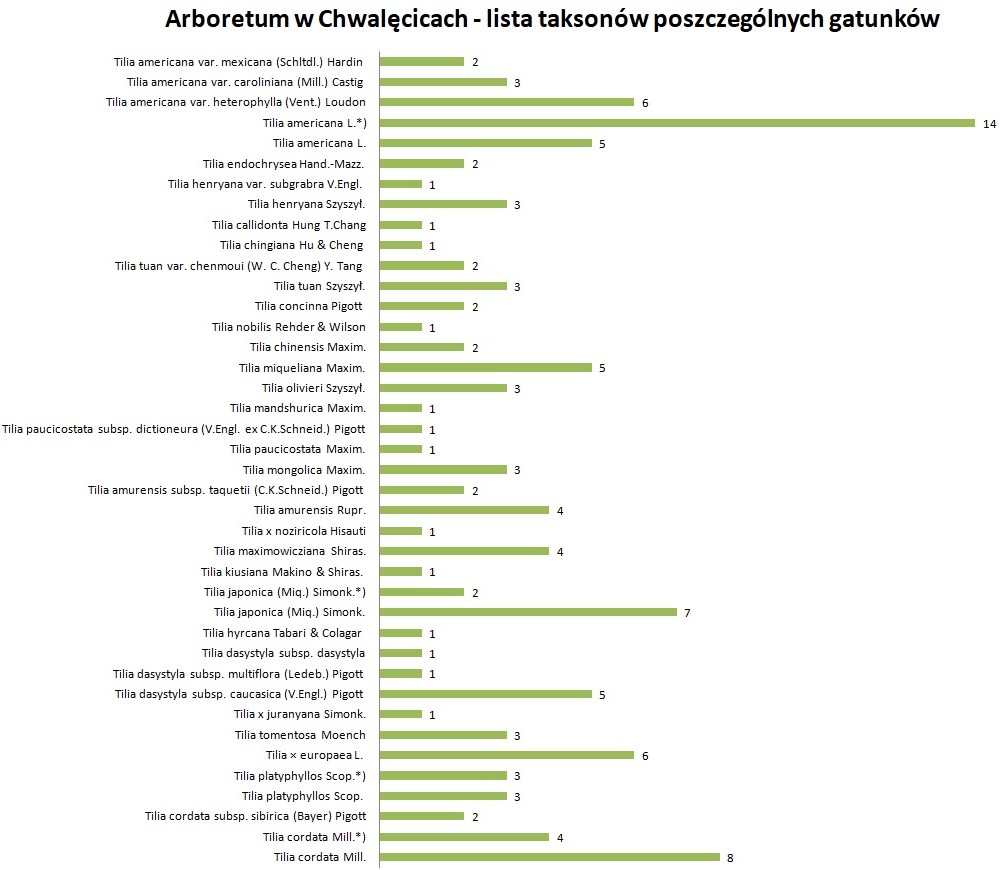
Species, with number of taxa ( *) signifies cultivars)
Currently, we carry out research into reproduction and growth of linden trees in Central Europe climate in collaboration with science centers.
We observe phenology of linden trees and bee activity on different taxa of Tilia. We reproduce the trees generatively (in addition to the vegetative method), mostly from seeds collected locally, attempting to select trees which start to flower in a young age and are well-adjusted to the climate conditions.
Currently, we give much care to lindens reaching only small sizes, allowing their cultivation in "pocket-sized" gardens.
Text and photos: Marek Pogorzelec
Legal note
Article "The National Collection of Genus Tilia" (text and graphics) is licensed under CC BY (attribution). I hereby allow copying, modifying and distributing of the work for commercial and non-commercial purposes, provided that author's name and a link to the source publication is attached.
Bibliography
1) Lime-Trees and Basswoods: A Biological Monograph of the Genus Tilia, Pigott Donald, Cambridge University Press, 2011
2) Trees end Shrubs Online - International Dendrology Society, dostęp 4/2021 (https://treesandshrubsonline.org/)
3) James W. Hardin, Variation Patterns and Recognition of Varieties of Tilia americana s.l., American Society of Plant Taxonomists, 1990